


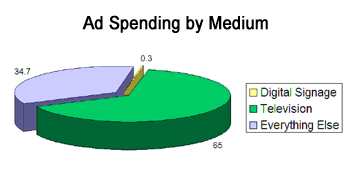
 To answer this question, let's start with some market data. PQ Media estimates the total size of the US digital out-of-home (DOOH) market at $1.3B, but only about $330M of that represents advertising revenue, with the rest going to capital and maintenance costs. To put that in perspective, the total US advertising market is about $120B, which means that less than 0.3% of ad dollars go to digital signage right now. By comparison, the TV advertising market that Google is chasing does about $77.5B, accounting for about 65% of the total. Thus, the TV market (including the broadcast, cable, local and Hispanic segments) is more than 200 times the size of the digital signage market.
Most TV advertising generates a net loss for the advertiser
Now for the really speculative part. Research suggests that CPG companies are only paid back $0.49 for every $1 spent on TV advertising. Non-CPG advertisers do almost twice as well, but still "break the buck," earning only $0.81 for each $1 spent. So if we put TV advertising in its own little box, disconnected from other parts of a brand campaign, it's a losing proposition. In other words, TV is only profitable when working in conjunction with other media to influence the viewer.
As far as I'm aware, there is no similar statistic indicating the relative "payback" for advertising on digital signage projects. My own gut feeling is that it's slightly positive, perhaps yielding an average return of $1.07 or $1.08 for each $1 spent. There's also huge variety, with some ads producing $3-$4 in value for each $1 spent, while others show much poorer performance. But unlike relatively staid and standard 30-second spots for TV, advertisers have their choice of formats and venues when it comes to digital signs, making any kind of like-like comparison very difficult. Further, TV advertisers have had a long time to hone their craft, so it's unlikely there will be a dramatic improvement in performance anytime soon. In comparison, the ongoing refinement of digital signage design techniques continues to produce better ad performance.
Digital signage ads provide a better return than TV
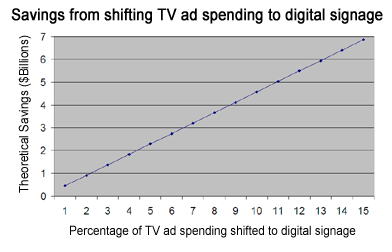 So what does it all mean? Simply put, if we assume that my estimate above isn't wildly off the mark (and it might be), then for every dollar that comes out of TV advertising and gets put into digital signage advertising, a CPG advertiser would "recover" the entire $0.51 loss and then generate a small profit on the original amount spent. (This is based on an average return of $1.08 for digital signage versus $0.49 with TV, each on a per-dollar basis.) For an advertiser that spends $10M a year on TV, simply moving 10% of that into digital signs would be like reducing their ad budget by $590,000 without sacrificing performance. In fact, there would probably be a performance boost, since their skills with designing and deploying ads for digital out-of-home environments would improve with experience. If we extend this trend to the advertising industry as a whole, moving 10% of TV ad spend into digital signage would save $4.5B per year, with no loss of performance and lots of upside potential.
What's stopping this from happening? For starters, the pivotal number in my argument is made up. I don't know for sure that there's a net positive return on most digital signage advertising -- I just think there is based on my own experience. Likewise, the amount lost or returned for TV commercials is a subject of much debate, so we can't count on it either. But I'm confident that dollar for dollar, a well-designed spot running on a well-placed digital sign should outperform a similar TV commercial by a wide margin. While I doubt there's any consensus from the industry at large, I'd like to know your thoughts on the matter:
All else equal, will a spot on a digital signage network "do" more than a spot running on TV? And where does the bulk of an in-store ad's value come from: "hard" sources like sales lift, or "soft" sources like brand recognition?
 Subscribe to the Digital Signage Insider RSS feed
Comments
RSS feed for comments to this post