
Hardware, software and expert advice for digital signage and kiosks
 Home Products Solutions Blog Support Company News Contact
Customer Login 
Digital Signage Insider SignageWire
Latest Articles Full Article List

The Digital Signage Insider
WireSpring's blog featuring tips and analysis from a team of industry experts

Is the Digital Signage Industry Still Growing?

Author: Bill Gerba on 2010-01-27 14:46:00

Whether you pose this question to a wide-eyed entrepreneur or a seasoned veteran in our space, it's pretty obvious what the answer will be. In fact, ever since the term "digital signage" gained traction about a decade ago, the hardware, software, services and advertising segments of the market have seen double-digit gains (or more!) every single year. And new reports from Frost & Sullivan, PQ Media and a number of others tell us that that while the rate of increase may start to decline a bit, we should continue to see healthy growth for some time to come. I was thinking about this while studying the web analytics for wirespring.com and this blog's subscription sources -- via RSS, email and plain old web page views. You see, starting in 2005, the blog saw geometric growth in its number of subscribers every year until 2008. Then, suddenly, the growth rate became linear. In searching for an explanation, I noticed something interesting: according to the Google Trends tool, the growth in the number of queries for key terms in our industry has slowed down dramatically in the last year or so, mimicking what I'm seeing on our blog. While I don't think this is a perfect analogue to what's actually going on in the market, it could indicate that we're reaching a critical growth point where hype and volume matter less. Well... maybe.

What does Google Trends say?

Google Trends is a web-based tool that tracks the number of search queries and news articles submitted for various keywords. Although Google is immensely popular, and so many people use it, the main shortcoming of Google Trends is that it can be unreliable for search terms that don't have a huge amount of volume. This latter group includes the vast majority of search terms important to our industry. However, when you plot a few of the popular-enough terms over a couple of years, Google clearly shows a slowing growth curve. Take, for example, these queries for two popular search terms, "digital signage" and "digital signage software". I added the green line to the first graph to show the approximate "best fit" curve, but these are otherwise unchanged from the Google Trends output:
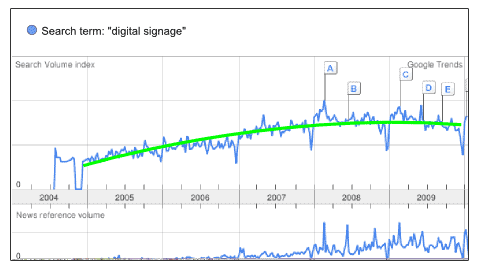
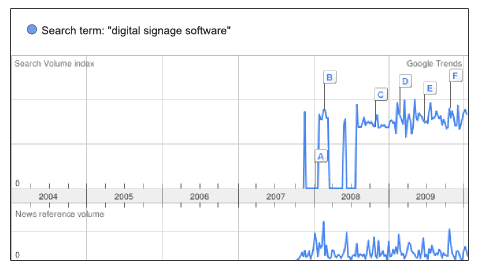


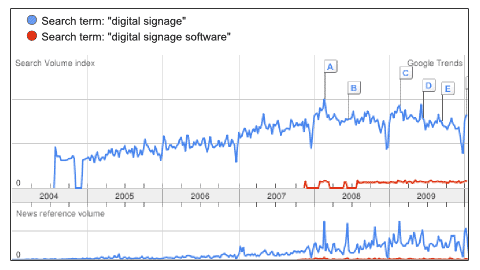
Discarding seasonal anomalies like the year-end slowdown well known to so many industries, search volume actually peaked in 2008, and saw a very slight decline in 2009. I'm sure the recession played a large part in that, but even during the bulk of 2008 there was little change in the search volume for these terms. What's more, the overall news volume at best held steady during that time. This tells me one of two things: either those companies who normally do lots of PR aren't accelerating their actions (probably because determining the ROI for a given piece of PR is very challenging), or, since there are more companies in the marketplace than ever before (which seems true, anecdotally), the average number of releases per company may actually have declined a bit. If you're wondering about those flat lines on the "digital signage software" trend graph, that's because that term just barely has sufficient search volume to register on Google Trends. If you graph "digital signage" and "digital signage software" together, you can see that "digital signage" by itself gets about an order of magnitude more search volume, on average:

Less hype? Isn't that just wishful thinking?

I'm no fan of industry hype, and I suspect everybody knows that by now. So I suppose the above analysis could simply be a case of me wishing that things would change for the better. On the other hand, my company's success depends on the growth and success of the industry, so it's really not in my best interest to think that our growth rate is going to fall off a cliff.

Are there other ways to explain what's happening?

Of course there are, and most of them make things look less dire. For example, since 2007 our industry's main news portals and blogs have become much more popular and professional, so they may be absorbing some of the traffic that would previously have gone to Google. Likewise, there are newsletters, clipping services, magazines and e-zines, and other forms of marketing and news publications that get pushed out to hundreds of thousands (if not millions) of people now, which again may be taking some amount of search volume away from Google.

Another explanation is that as our industry matures, we ought to see fewer tire kickers and more serious buyers. On the high end of the business spectrum, these buyers may do fewer and more concentrated searches, or might be turning to other avenues like consultants, trade shows, and partnerships with existing vendors and VARs to learn about products and services. On the low end, mom and pop businesses are probably using a wider variety of search terms based on their particular needs. For example, if people are getting useful search results from a query like "digital restaurant sign" because there are now enough vendors providing that service (and enough articles about it) to make the first web search a success, they might never have the need to do a broader search for "digital signage." Both of these trends -- if correct -- would be great, because they signal the start of our industry's next phase, where solution specificity and bona fide business relationships become increasingly important, making general hype less effective (and thus theoretically less pervasive over time).

What about additional data points?

If it were up to me, I'd have to say that yes, the digital signage industry is growing. It doesn't take a $1,500 research report to notice the huge number of screens being placed in virtually every conceivable out-of-home space these days. However, when it comes to the volume of research being conducted over the Internet, I'm less sure. It seems possible to me that we may have plateaued, in which case we might not see another big spike in activity until a) the economy improves, b) some technical innovation is made that significantly lowers the cost of entry, or c) something dramatically increases the amount of attention that our technology and medium receives. The question is, which of these things will happen, when, and what will be the driving force behind them?

Is the market for digital signage still growing? If so, how quickly, and what's driving that growth? If not, what do you think will spur the next wave of development in our space? Leave a comment below and let me know!

Comments (12)

Subscribe to comments for this article | Trackback

2010-01-27BOB BARRETT writes:
The software for digital signage should be in
a price range to include in the purchase of any
new PC.It also should be part of any Adobe package. To me, I don't know why I should purchase what from Adobe. If they said the final results would be the ability to have
"DIGITAL SIGNAGE CAPABILITY" THAT WOULD BE GREAT. But not at $ 1000.00.
2010-01-27Byron Darlison writes:
From my perspective I think the market for "displays" is growing but I think the niche that we call "digital signage" is being squeezed out and is being replaced by a convergence of technologies - mobile, interactive, ipads, chrome, html5, etc. etc. and this convergence will require a very different approach from what we have brought to the table so far, that is if we want to see continued growth.
2010-01-28Social comments and analytics for this post writes:
...This post was mentioned on Twitter by billgerba: Just published "Is the Digital Signage Industry Still Growing?" on Digital Signage Insiders: http://bit.ly/bsoLZn Google says: maybe....
2010-01-28Robert Kincaid writes:
The DSN industry is like the State of the Union. While the republicans try to blame the reccessive-depressive economy on Obama, the DSN-network operators industry needs to rightfully-so blame the advertising industry for the plateauing and near recessive growth of our DS industry. DS network owners, suppliers, integrators, investors, etc. , (really our entire supply chain) have absolutely let them off the hook. We have not held their feet to the fire in the spirit of bi-and-tripartism. We all have been (especially networks) reaching out across the isles to advertisers for 4 years, to sponsor pilots and grow our networks. That's how products are sold and jobs created Mr. & Mrs. Madison Avenue.

Advertisers-like republicans keep saying no, no, no, we don't want to participate. They're still clinging to a wait-and-see mentality. While signage, mobile, web, and now tablets-PCs are undergoing revolutionary innovation and adoption. Wake up! Broadband is nearly everywhere! Where there's broadband, there are consumers with digital devices digesting and transacting content and data.

Where are the commercial brands and e-Commerce apps for all these expanding devices. You want 3rd party auditing? In this past 4Q, 9 million additional iPhone's were sold. Something like 21 million iphones are now in circulation. Geez! how many units do advertisers (agencies, too) need before they are convinced that consumer are on the other end ready to spend. Every, I mean every advertiser should be on the iPhone by now. Every advertiser should be poised for the Tablet-PC wars. Likewise, every advertiser (agency, too) needs to be actively exploring, if not buying digital signage network.

Again, this stimulates national job creation spanning in-house management jobs, content-creation jobs, sales & marketing jobs, service installation-integration jobs, and finally increased brand sales from consumers seeing ads on signage networks.

What the heck are advertisers (agencies, too) waiting for? Last I checked, the cost of an average 37" LCD-TV ($400) and a iPhone ($299) are fairly congruent. A LCD-TV impacts hundreds of viewers, while a iPhone impacts just one viewer. Therefore it makes more sense that advertisers invest in DSN per CPM versus the iPhone. Both have their tremendous value proposition for increasing product sales. But if advertisers (agencies, too) remain obstinate to participating in our industry growth, they will never reap the ROI for their brands and clients during the most innovative digital revolution.

Lastly, we will still be having this conversation in 2012, if we don't "March on Madison Avenue."
2010-01-28Lionel Tepper writes:
Hi Bill,

Interesting post. I had been thinking about the "Digital Signage" search term issue for a while and recently wrote an article about this issue addressing some of the myths and misconceptions that have been taken as fact by many people within the digital signage industry. 

As you pointed out in "Google Trends" the search volume for the term "digital signage" is very low.
"Digital Signage" search volume hit 90,000 at its peak in October 2009. This number is very, very small number when you consider the fact that there are 400 million Web search request per day, billions per year— 90,000 does not even qualify as a rounding error when you consider the total overall search volume. Yet, so many companies in this industry are "hell bent" at getting to the top of the list on Google for this keyword. These folks (and you know who you are) are not seeing the forest for the trees! 

Most customers are NOT searching for solution using the keywords "digital signage" online. The numbers speak for themselves. I have a thought about this issue and have come to some conclusions:

Reports of increased search volume for the keywords "digital signage" are not accurate: There's a direct parallel that can be drawn between the rise in search volume for the keyword “digital signage” and the increase in the number of registered domains for providers and services within the space. As one might expect, a percentage of this increased search volume has been generated by the industry itself, creating an artificial rise in search queries for digital signage; therefore, some, if not all of this increase should be discounted.

Don’t assume that customers know what to call a new technology that is just beginning to gain momentum: Search terminology needs to be relevant to end-users. A keyword’s real value is completely dependent on how common it has become in regular English usage. “Digital signage” is not currently in the mainstream of English usage. While many people have seen digital signage, few people know specifically what to call it. If you don't believe it—ask around. If you ask people (outside of this industry) what "digital signage” is, most people will not know the answer. They will know it if you describe it, but most people won't know the terminology specifically.

The Adoption Curve: Most successful innovations go through an adoption curve that slowly ramps toward majority acceptance. Digital signage is still at the beginning of the adoption curve and has a long way to go before it is widely embraced by the majority. What the industry has experienced to date are “innovators” and “early adopters”—the point of critical mass is still several years away.  Therefore, it’s too early in this technology’s adoption curve to focus specifically on “digital signage” as the center of any online marketing strategy.

I see the number of digital signage installations in my local area (New York City) increasing all around me in both large and small venues. So clearly the technology is on a growth path and information about the benefits of the technology is spreading. However, I think the industry itself is thinking too narrowly about marketing tactics. The industry needs to diversify marketing tactics to maximize exposure. Marketers within the digital signage industry need to be thinking "in parallel" with customers. There is far too much emphasis placed on the "Digital Signage" keywords at this stage of the adoption curve. The industry must diversify its strategy if we are going to be successful at reaching new clients and markets.

The original article, Why everything you thought you knew about Google and “digital signage” keyword marketing— is wrong, can be read here: http://www.digitalsignageuniverse.com/marketing25.html
2010-01-28Lionel Tepper writes:
Hi Bill,

Interesting post. I had been thinking about the Digital Signage search term issue for a while and recently wrote an article about this issue addressing some of the myths and misconceptions that have been taken as fact by many people within the digital signage industry. 

As you pointed out in Google Trends the search volume for the term digital signage is very low.
Digital Signage search volume hit 90,000 at its peak in October 2009. This number is very, very small number when you consider the fact that there are 400 million Web search request per day, billions per year— 90,000 does not even qualify as a rounding error when you consider the total overall search volume. Yet, so many companies in this industry are "hell bent" at getting to the top of the list on Google for this keyword. These folks (and you know who you are) are not seeing the forest for the trees! 

Most customers are NOT searching for solution using the keywords digital signage online. The numbers speak for themselves. I have a thought about this issue and have come to some conclusions:

Reports of increased search volume for the keywords digital signage are not accurate: There's a direct parallel that can be drawn between the rise in search volume for the keyword digital signage and the increase in the number of registered domains for providers and services within the space. As one might expect, a percentage of this increased search volume has been generated by the industry itself, creating an artificial rise in search queries for digital signage; therefore, some, if not all of this increase should be discounted.

Don’t assume that customers know what to call a new technology that is just beginning to gain momentum: Search terminology needs to be relevant to end-users. A keyword’s real value is completely dependent on how common it has become in regular English usage. Digital signage is not currently in the mainstream of English usage. While many people have seen digital signage, few people know specifically what to call it. If you don't believe it—ask around. If you ask people (outside of this industry) what "digital signage” is, most people will not know the answer. They will know it if you describe it, but most people won't know the terminology specifically.

The Adoption Curve: Most successful innovations go through an adoption curve that slowly ramps toward majority acceptance. Digital signage is still at the beginning of the adoption curve and has a long way to go before it is widely embraced by the majority. What the industry has experienced to date are innovators and early adopters—the point of critical mass is still several years away.  Therefore, it’s too early in this technology’s adoption curve to focus specifically on digital signage as the center of any online marketing strategy. The Adoption Curve: http://en.wikipedia.org/wiki/Diffusion_of_innovations

I see the number of digital signage installations in my local area (New York City) increasing all around me in both large and small venues. So clearly the technology is on a growth path and information about the benefits of the technology is spreading. However, I think the industry itself is thinking too narrowly about marketing tactics. The industry needs to diversify marketing tactics to maximize exposure. Marketers within the digital signage industry need to be thinking "in parallel" with customers. There is far too much emphasis placed on the "Digital Signage" keywords at this stage of the adoption curve. The industry must diversify its strategy if we are going to be successful at reaching new clients and markets.

The original article, Why everything you thought you knew about Google and digital signage keyword marketing— is wrong, can be read here: http://www.digitalsignageuniverse.com/marketing25.html
2010-01-28Stan Robinson writes:
We continue to see growth in the Digital Signage industry in terms of the scope, complexity and creativity involved in its applications across industries. The recession has definitely slowed the speed with which organizations are adopting Digital Signage technologies. However, as Bill Gerba points out, potential users are probably also turning toward other resources such as consultants and integrators for more in depth research on these technologies. The concept of efficiently getting the right message across to the appropriate audience will only continue to increase in importance.
2010-01-29Jessica Mason writes:
Hi,
A very informative article about the success of digital signage. I would like to add more about digital signage success. 2007 was good year of digital signage as New supplier increasing, Investment funding increasing on advertising, Changing in the supplies and operating structure of digital signage. In 2008 digital signage convert in to communication and other application environment and technology changed by time. Now the world is going in to the digital signage, Technology changing rapidly. A new network plan to the success will take a new strategic approach.
2010-01-29Bill Gerba writes:
Lionel, I was waiting for somebody to make that point, and it's completely valid. One can't merely use a keyword or two as a proxy for the entire industry. By the same token, though, it's extremely unlikely that we've simply exhausted all growth in that keyword as our industry continues to grow (and especially if it's growing as fast as all of these nonsense "research" reports say it is).

Per your report on the adoption curve, I was looking for some information about this very thing online, but couldn't find any. However, I'm willing to bet money on the term "digital signage" continuing to grow even after we pass the hype peak and enter into the maturation stage, simply because the audience size grows exponentially after that point, and some portion of those people are going to be querying a simple term like "digital signage", "digital sign" or some variant thereof.
2010-01-30Lionel Tepper writes:
Hi Bill,

Regarding keyword marketing, I agree that there will be plenty of growth for online search marketing once the technology reaches the point of maturation. My point was only to help companies within the industry to understand that we are not there yet—despite all of the hype that this business puts out. I should know since we see all of it. I'm glad to see that so many people are excited about the growth that we have seen so far, but there are many challenges ahead for the business.

My experience as a marketer gives me a different perspective. While I am very optimistic about the future of the technology and growth for the business—I'm also a realist. Even under the best economic conditions there are significant hurdles that need to be crossed. But given the current economic difficulties that we all face as an industry, and as a nation, I think that significant growth will be harder to measure. I have hope, but—Hope is not a strategy.

Going into 2010-2011 most companies will maintain a highly defensive stance regarding their spending. The case for increased ROI for digital signage must be made stronger than ever.

It also means that media outlets such as ours need to responsible to put out credible information and ignore the over-hyped nonsense that too many companies are guilty of distributing.

This week the Gov't reported a higher than expect GDP which is encouraging, however, in hindsight I think this is a blip on the radar screen and does not indicate real growth. The thing to really keep an eye on in my opinion is growth in State Sales Tax receipts. If local governments begin to report higher Sales Tax revenue—then you know that consumers are spending again—and the real recovery is in motion. I think this is not going to happen for a while as long as unemployment stays high. This will slow the growth of the Digital Signage business (and all business) in the near term.

You also have to hope that the coming tax increases for corporations (Yes, your taxes WILL go up) won't put an additional drag on capital spending. The near-term big picture looks murky to me. Although, I am very optimistic long-term.

Getting back to the "digital signage" keyword issue, I hope that marketers within this space "wake-up" to the fact that they are wasting their time on a futile exercise. Getting to the top of Google's search engine for the keywords "digital signage" is not the holy grail of marketing success. Maybe in 5 years it will matter, but not now.

The value that Web portals like Digital Signage Today, The DailyDOOH, and ours (Digital Signage Universe) bring to the industry is high visibility—because we all attract traffic that goes well beyond a single keyword. Just food for thought for those looking to raise their visibility in this market.
2010-02-01manolo almagro writes:
depending on who you ask, the industry at large -is alot like our known universe. Both contracting and expanding at the same time. The difference in viewpoint has a direct correlation to their fixed position in space. On a global scale - yes, there is a significant of expansion, and it accelerates as you move from the western hemisphere to the east. The key growth is being driven in the emerging markets (S.E. Asia and EMEA)vs. the US's more mature market. Whereas in the US, growth is slowed or stagnant especially in the retail sector, with the most opportunistic segments being outdoor and transit.
2010-02-16Jessica Mason writes:
Hi,
As compared to the past Digital signage growing well in the market. However in few state you can say that. but overall its emerging well. Digital signage is good way of communication to get the attention they deserve and create the impact you want. Once Charles said "High Achievement always takes place in the framework of high expectation".As this technology rolls out into the mainstream, it could give digital signage advertising networks a significant boost among media buyers as there finally will be concrete,verifiable metrics upon which to make ad buys and allocate budgets.

Leave a Comment

Name:
Email Address:
(required but won't be shown)

Website:
Comment:
(max 2000 characters)
Are you a human? If so, uncheck this box:


Digg this! | Del.icio.us


Previous Article: Intel, Microsoft and the Open-Standards Digital Signage Platform
Next Article: POPAI Code of Conduct: Taking a Stand on Digital Signage Privacy

Front page of Digital Signage Insider Blog

LEGAL STUFF: The Digital Signage Insider is written by multiple authors. The author of each article is clearly identified at the start of the article. The opinions expressed in each article are solely those of the author, and do not reflect the official opinions of WireSpring Technologies, Inc. All articles are copyright © 2004-2009 by their respective author. All content besides the actual article text, e.g. surrounding branding and informational content, is copyright © 2000-2009 WireSpring Technologies, Inc. All rights reserved. Except as provided in WireSpring's Republishing and Syndication Policy, no articles may be reproduced, in whole or in part, without WireSpring's express written consent.

Subscribe to our RSS feed


  Subscribe via XML/RSS/RDF

About this blog and our team
WireSpring provides hardware, software and services for digital signage and kiosk projects. But this blog is a labor of love. Our posts cover everything from case studies to creative briefs, and we post new articles several times a week.

The blog team:

Our blog team includes some of the industry's most well-respected leaders:

Founder and Senior Writer:
Bill Gerba

Editor:
Jeremy Zaretzky

Writers:
Gary Halpin, Agency 225
Pat Hellberg, Kaicon
Hercules Huggins, WireSpring
Dr. Alice Julier, University of Pittsburgh
Darren Kubel, WireSpring
Christie Liu, Strategy Institute
Graeme Spicer, Adcentricity
Axel Vera, Infusion Marketing
Roberto Vogliolo, Artexe

If you would like a member of our blog team to provide feedback for a story you're working on, or you want them to speak at your event, please contact us.

Editorial policy:

Article topics are selected by our writers and editors, with the goal of providing objective and useful information to the entire digital signage industry. This means covering a lot of projects that have nothing to do with WireSpring's products, and we're fine with that. Whenever we mention a project that WireSpring is directly involved in, we'll be sure to provide appropriate disclosure in the text. If you'd like to suggest a topic for a future article, feel free to leave a comment or contact us. We don't take very kindly to PR spam, so please review our past articles before contacting us to verify that what you're planning to send is a good fit for our audience.