
Hardware, software and expert advice for digital signage and kiosks
 Home Products Solutions Blog Support Company News Contact
Customer Login 
Digital Signage Insider SignageWire
Latest Articles Full Article List

The Digital Signage Insider
WireSpring's blog featuring tips and analysis from a team of industry experts

Is Digital Signage SaaS "Greener" Than Hosting Your Own Server?

Author: Bill Gerba on 2009-06-05 10:02:38

I really don't like cause marketing. Adopting the facade of curing some social ill for the sake of selling product seems crass and opportunistic, which probably explains why I can't sit through more than a few minutes of Extreme Home Makeover without wanting to smack someone. The latest cause craze these days is of course the green-ifying of everything. Marketers are slowly but surely training us to believe that we're evil if our light bulbs and laundry detergent aren't saving the environment somehow, and the trend is growing. While I have absolutely nothing against preserving the environment -- and I'm actually psyched that such a cause is fostering innovation in virtually every industry these days -- I'm getting pretty tired of getting hit over the head with the green bible every time I walk into my local supermarket. Still, I need to take green seriously, since as a digital signage vendor my world revolves around lighting up thousands of LCD, LED and plasma displays. In the past, I've helped a couple of customers do the math to determine their network's total power output and even complete carbon footprint. But the other day I was caught by surprise when someone posed a new question: is software-as-a-service (SaaS) green?

First off, "green" is a pretty relative term when you're talking about lighting up 500W displays all over the place. But the key question, "Does software-as-a-service use more or less power than a self-hosted and locally-managed application delivery" seems valid enough. And certainly my initial guess was "yes, it must be, since there should be fewer computers providing the service." Still, I hadn't done the math, and since the company I was speaking to has a big reputation for taking their projects green, I didn't want to screw up. After spending a little time doing some research and plenty of guesswork, I came up with some not-unbelievable yet not-terribly-satisfying figures that I thought I'd share and get some feedback on.

Assumptions, please


Image credit: Martin Gommel
You know what happens when people go assuming, right? They make an ass out of u and Ming (and if Flash Gordon has taught us anything, it's a bad idea to piss off Ming). Unfortunately there's no way that somebody could figure out an industry-wide average for things like server density, utilization ratios and power consumption without making some guesses, so here are mine:

  • The average network has 100 nodes (media players) attached. I actually think this is on the high side, with a more realistic estimate being in the 30-40 range, but in this experiment it's more conservative to round up rather than down (you'll see why in a minute).
  • It only takes one server to run a 100-node network. That means that everything -- management application, database, connection manager, etc. is running off of the same machine. That seems reasonable for only 100 units.
  • The typical self-hosted server draws 300W, and is turned on 24/7. You don't need the beefiest machine in the world to manage a 100 node network, so that seems reasonable.
  • The typical SaaS server cluster can manage 2,000 nodes. I'm drawing on personal experience here. If you forget about multi-cluster redundancy for a minute (which seems fair since we haven't figured in redundant servers for the self-hosted option), a "cluster" in my parlance is two servers: an application server and a database server.
  • Each SaaS cluster draws 1,000W, and is turned on 24/7.

Using that set of assumptions (which I expect I'll be told are wrong), we can develop this simple table of efficiencies:


So, based on the math above, a SaaS infrastructure may be six times as efficient as a self-hosted infrastructure on a watts-per-unit basis.

It's all about density, baby

There are plenty of places to take a wrong turn above, and since a good chunk of my company's revenues come from providing digital signage SaaS solutions, I thought it prudent to point out just how far off-the-mark the above calculations could be if we vary the assumptions a bit. The key is server density -- how many nodes you can manage on a single machine (or cluster) without it going up in smoke. I think my estimates for server wattage and the nodes/cluster for SaaS are pretty accurate, since those are all things I have first-hand experience with. But when it comes to the total number of nodes managed on a given server, as I noted above, my estimate's as good as the next guy's. Look what happens when you vary that number:
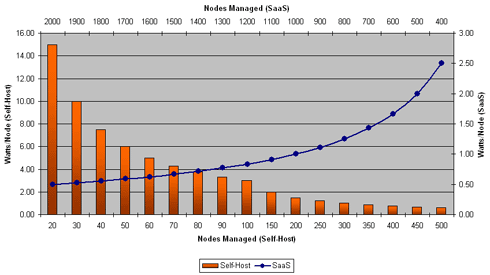


So you can see that at higher numbers, the efficiency of a self-host solution starts to approach that of a well-utilized SaaS cluster (assuming you can cram the management of 500 nodes onto a single low-power server) . Likewise, underutilized SaaS clusters, because of their high base power requirements, rate low for power efficiency -- a SaaS cluster managing only 400 nodes (i.e. a few small customers) isn't much better off than a customer hosting their own server for 100 nodes.

What are the real-world implications of this?

Going back to our original set of assumptions, let's add in some data from iSuppli that shows that 758,000 nodes of digital signage were deployed to the retail sector in 2008. This total would require either 7,580 individual servers each managing 100 nodes (for a total power draw of 2,274 KW), or 379 hypothetical SaaS clusters (which would draw only 379 KW). To put that in perspective, the difference is enough to power about 1,500 homes. If iSuppli's projections are accurate and we see the market size triple to 2.5M nodes in 2013, the consumption differences and savings would roughly triple as well.

Ultimately, the difference simply isn't that large, especially when you consider that those same hundred screens requiring a 300W server are each drawing 200-300W themselves. So at this point, I'd be willing to say that when it comes to digital signage, a well-managed SaaS infrastructure is likely to be more electricity-efficient than a typical self-hosted solution. However, the difference is fairly modest, varies from network to network, and is certainly not something I'll be putting into my sales pitch any time in the near future :)

When it comes to digital signage, how important do you think it is to be green?

Comments (7)

Subscribe to comments for this article | Trackback

2009-06-05Annie writes:
Bill:

I like the fact that you manage not to annoy Ming and come to some empirical conclusions that are cautious. The commercial claims about green-ing technology are so ubiquitous they lose any moral power and open everyone up to charges of greenwashing. I'm always sad when Apple shows up low on the green technology list, but I appreciate it when they're realistic about change over time rather than beating you over the head with trumped-up examples.

I think one of the other key factors is when and how the service will be deployed -- that is, does it run all night long? can it be powered down at off-peak times? What are the site-specific variables that determine usage?

What's great about your conclusions is that it presents a starting point from which you can make other arguments for efficiency and use-value.

Annie
2009-06-05Bill Gerba writes:
Hi Annie,

Thanks for the feedback, and you make some great points. We definitely have worked on networks that were more eco-conscious and asked for specific tweaks like low-power media players, utilization of specific computer resources, and even some specific software tweaks to make the screens run a bit dimmer (when appropriate) and the players a bit cooler. And of course, as you note, scheduling the screens to turn on/off at designated times and allowing the players to go into their idle/hibernate states when not in use can show dramatic power savings.
2009-06-08Richard Lebovitz writes:
I'm glad to see this discussion as we hear a lot of talk about "green" in the digital signage industry but little to support the talk. We've likewise started a discussion on the Digital Signage Expo LinkedIn site, where we plan to reference your blog entry as one other source for information on this subject. What's perhaps missing here, as from other discussions on the subject, is the birth-to-death scenario for digital signage, i.e. what's the carbon footprint for manufacturing and end-of-life disposal as well as the operational aspects you cover so thoughtfully here.
2009-06-08Bill Gerba writes:
Hi Richard,

As mentioned I have done a couple of complete carbon footprint analyses for digital signage networks -- that includes everything from manufacturing the screens to shipping all the components to lighting them up, etc. I won't lie: the number is very large, even when using conservative estimates. The whole process also produces a lot of toxic waste, mostly in the form of chemical runoff from the LCD manufacturing and PCB etching processes, and chemical emissions (including Mercury and some radioactive stuff) from coal-burning powerplants that provide a good amount of US electricity.

All that said, though, I've had a very hard time determining whether the process is a whole lot worse than refreshing printed posters of a similar size on some regular schedule. Print inks are typically petroleum based and have a lot of similar toxicity and energy-intensity problems as digital, and of course there's more shipping to do over time.

When all is said and done, though, ultimately you're trading energy and chemical exposure for some "work." As long as that work's value is greater than that of the energy and material costs, people will continue to do it.
2009-07-10PhilGo20 writes:
Is the debate between SaaS and Self-hosted still happening in DS ?
Do vendors really hav to push it in 2009 ?
I honestly haven't heard any such kind of debate in the last year or so, except from government or public institution worried about security which is a different topic in my opinion.

Just curious how many DS SaaS platforms still have to evangelize clients on the merits of SaaS.
2009-07-10Bill Gerba writes:
Hi Phil,

There definitely is still a debate in the community, but most of the time it's not between vendors of one solution or the other, but between prospective customers (with their own prejudices and opinions) and the vendors they're seeking out.

I do think that today's customer comes into the argument armed with a lot more information and many fewer false impressions than before, but there are definitely quite a few people out there who start out with a notion that one type of solution is somehow inherently better than another.

I just wrote an article on July 9th, in fact, about some of the arguments typically made for and against digital signage SaaS solutions, if you'd like to check that out.
2010-08-06digital signage saas writes:
I prefer saas solutions as although it is more expensive it takes some of the pressure away from you and means that it is easier for you to do your own job and leave your signage to the professional. After all, thats why your paying them so you should get your money's worth.

Leave a Comment

Name:
Email Address:
(required but won't be shown)

Website:
Comment:
(max 2000 characters)
Are you a human? If so, uncheck this box:


Digg this! | Del.icio.us


Previous Article: Got a Question for the Head Honchos at Disney, J&J or Walmart?
Next Article: Why I'm Really Looking Forward to the InfoComm 2009 Trade Show

Front page of Digital Signage Insider Blog

LEGAL STUFF: The Digital Signage Insider is written by multiple authors. The author of each article is clearly identified at the start of the article. The opinions expressed in each article are solely those of the author, and do not reflect the official opinions of WireSpring Technologies, Inc. All articles are copyright © 2004-2009 by their respective author. All content besides the actual article text, e.g. surrounding branding and informational content, is copyright © 2000-2009 WireSpring Technologies, Inc. All rights reserved. Except as provided in WireSpring's Republishing and Syndication Policy, no articles may be reproduced, in whole or in part, without WireSpring's express written consent.

Subscribe to our RSS feed


  Subscribe via XML/RSS/RDF

About this blog and our team
WireSpring provides hardware, software and services for digital signage and kiosk projects. But this blog is a labor of love. Our posts cover everything from case studies to creative briefs, and we post new articles several times a week.

The blog team:

Our blog team includes some of the industry's most well-respected leaders:

Founder and Senior Writer:
Bill Gerba

Editor:
Jeremy Zaretzky

Writers:
Gary Halpin, Agency 225
Pat Hellberg, Kaicon
Hercules Huggins, WireSpring
Dr. Alice Julier, University of Pittsburgh
Darren Kubel, WireSpring
Christie Liu, Strategy Institute
Graeme Spicer, Adcentricity
Axel Vera, Infusion Marketing
Roberto Vogliolo, Artexe

If you would like a member of our blog team to provide feedback for a story you're working on, or you want them to speak at your event, please contact us.

Editorial policy:

Article topics are selected by our writers and editors, with the goal of providing objective and useful information to the entire digital signage industry. This means covering a lot of projects that have nothing to do with WireSpring's products, and we're fine with that. Whenever we mention a project that WireSpring is directly involved in, we'll be sure to provide appropriate disclosure in the text. If you'd like to suggest a topic for a future article, feel free to leave a comment or contact us. We don't take very kindly to PR spam, so please review our past articles before contacting us to verify that what you're planning to send is a good fit for our audience.