


This week I planned to sit down and update the ad sales estimate number using the data from our 2011 pricing survey. However, when applying the data two things quickly became apparent: first, if you consider just at the capital expenditures, which are normally made upfront, there was only a 5.6% decline in our pricing index between 2010 and 2011. That's obviously not going to result in dramatic changes to our estimates. But second, when evaluated in light of last week's conclusion that a 100-screen network might take 12 employees to operate, it would seem that higher operating costs could make reaching the breakeven point more difficult than our January analysis suggested.
How many advertisers did it take to fund a 100-screen network in 2011?
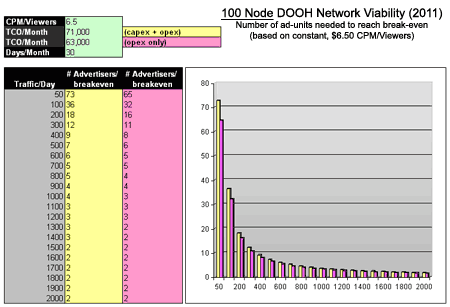
Just as in our January article, the number of advertisers needed depends on the amount of traffic the venues typically receive. The greater the amount of traffic, the fewer discrete advertisers needed, since each ad placement would sell for more (i.e. some multiple of the $6.50 median CPM/Viewers we identified in late 2011). However, this chart no longer tells the whole story.
The problem: even small DOOH networks face considerable fixed operating costs
You'll notice that there are two series in the chart above. The yellow series indicates the number of ads needed to break even on operating expenses while also paying down capital expenses, while the pink series focuses only on operating expenses, as if the capital costs were zero. (In these calculations, operating expenses are equal to staffing costs plus the cost of management software and tech support.) As you can see, because the operating expenses are so considerable relative to capital costs over the course of three years, leaving out the capital costs doesn't really affect things much. This led me to wonder whether I have been wrong all these years, and the key to success in the DOOH marketplace is not a conservative, metered approach but rather a massive burst of deployments early on.
The solution: front-loaded scale
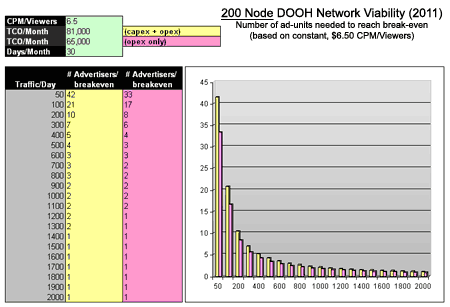
As this second chart illustrates, doubling the number of screens from 100 to 200 would (theoretically) double the number of (thousands of) viewers the network has access to. However, the cost of this doubling would be front-loaded: while capital expenses would double versus our 100-screen projections, operating expenses would barely increase at all, and there are twice as many screens to spread the operating costs over. So, by front-loading the investment (and thus the risk), a new DOOH network could cut the number of advertisers needed to break even nearly in half. Of course, this assumes that the same advertisers would be willing to buy space on all of the screens in the network. But as we've learned from our DOOH advertising survey, advertisers love scale, and they think (and buy) in terms of reach, which is inherently tied to scale.
The bottom line is this: if you're investing in a DOOH network, you'd be crazy to not fund enough screens to bring the required number of paying advertisers down to a reasonable level. And I'd extrapolate this one step further: I wouldn't be surprised to find that there is some baseline number of screens below which it is impossible to make an ad-funded network profitable. Judging from the number of failures we've observed in this industry, I would be equally unsurprised to find out that most of the DOOH networks that have ever been deployed got stuck at or below this level, because of difficulties raising the funds to expand. Now I'm sure that in many of those failed cases, there were additional factors: inexperienced sales teams, poor budgeting, and so on. But it may well be that investors, unwilling to "throw good money after bad," unintentionally sabotaged themselves by not recognizing the relationship between opex (NOT capex) and the breakeven point.
How big does a DOOH advertising network need to be in order to turn a profit? Are there other monetization strategies that make sense for very small networks? Leave a comment and let us know.
 Subscribe to the Digital Signage Insider RSS feed
Comments
RSS feed for comments to this post