


So, who provides some numbers we can look at?
From our article on digital signage growth rates a few months ago, we found three pretty good sources of digital signage industry statistics -- both ABI Research and IMS Research have been running the numbers on the nuts-and-bolts side for several years, and PQ Media has done a great job following the DOOH advertising industry. Each group has published at least two reports in the last few years, and each group has provided some of the critical baseline numbers and growth projections in their executive summaries and press releases, meaning it won't cost me $50K to research the numbers for this blog post.
In short, assuming that these guys didn't go back and doctor the numbers in earlier reports to reflect later findings, and also assuming that all three continued to use a consistent methodology for measuring whatever it is that they measure, all three were reasonably decent at predicting growth and growth rates. It almost disappoints me to say that the level of ridiculous hyperbole found elsewhere in our industry just wasn't present here.
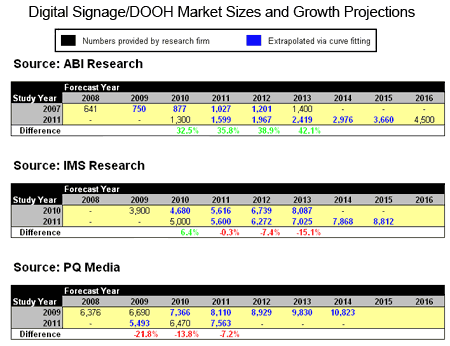
As you can see, ABI Research, who had the biggest chronological gap between comparable data sets (4 years), actually underestimated market growth in 2008 -- to the tune of 32.5% in 2010 and 35.8% in 2011, assuming the methodology remained the same. If the trend holds and their future predictions are reasonably accurate, the market will continue to outperform their original expectations for the next several years. IMS Research, on the other hand, had highly consistent results, with predictions from their 2011 survey differing by only a few percentage points from their 2010 numbers. Given that their data sets are only one year apart, that is not at all surprising. Finally, in the DOOH space we see PQ Media showing bullish predictions for 2009, only to have the economic realities and corresponding growth challenges cause a massive 22% correction once the numbers were considered again in 2011. The rest of the overlapping data was much closer, and PQ's ongoing CAGR estimate of around 10% is considerably more conservative than earlier predictions.
The three research firms study somewhat different things, but they're all tempered by the overall market penetration of digital signage systems. Consequently, we can observe that PQ was generally bullish, ABI was generally bearish, and IMS was somewhat neutral. (In each case, we're talking about the precision or conistency of their predictions, rather than accuracy, since we don't have any way of verifying how their historical data is being calculated.) Generally speaking, then, the research firms are not putting out wildly hyperbolic data.
What can we do with the research data?
While each of these research reports offers a lot more than just broad industry size and growth predictions, the true value of these things comes over time, as we can compare the predicted size and growth numbers with their historical counterparts. Further, we can compile several different firms' numbers together to create a composite. This is meaningless in terms of dollar amount, but may more accurately illustrate the overall growth and direction of the industry:
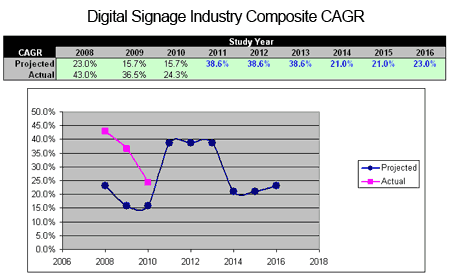
I hope to keep this chart up-to-date as the various research firms publish new data in the coming years. However, given the differences in things being measured and the sporadic publication dates, this composite figure probably isn't going to be too helpful.
Introducing the Digital Signage Sentiment Survey
With this in mind, I would like to introduce a new survey which we'll conduct a few times each year. At only 3 questions long, it should be very quick to complete, and will hopefully serve as a barometer for the industry -- as well as a source of historical data. So without further ado, I present the Digital Signage Sentiment Survey, which will yield our first-ever Digital Signage Sentiment Index!
If you're reading this article in a web browser, the survey should appear below. If you don't see it, simply click this link to take the survey.
We'll publish the results in the next week or so, and then do similar follow-up surveys throughout the year. With this information in hand, we should be able to gauge the level of industry optimism at any given point, and see how the current levels compare to how we've felt in the past.
Do you work with industry research firms or purchase their reports? If so, how do you use the data? Do you feel that it provides a competitive advantage? Leave a comment and let us know!
 Subscribe to the Digital Signage Insider RSS feed
Comments
RSS feed for comments to this post