
Hardware, software and expert advice for digital signage and kiosks
 Home Products Solutions Blog Support Company News Contact
Customer Login 
Digital Signage Insider SignageWire
Latest Articles Full Article List

The Digital Signage Insider
WireSpring's blog featuring tips and analysis from a team of industry experts

3 Reasons Why Mobile Marketing Will NOT Replace Digital Signage

Author: Bill Gerba on 2009-02-17 14:15:48

Mobile marketing might be the only industry surrounded by more hype than our own right now, and that's really saying something. The mobile marketing folks have conferences, launch parties and industry associations that make the digital signage bandwagon look cautious and reserved by comparison. Yet when it comes to showing real, meaningful results and genuine conclusions, they're in the same boat as we are. Thus, I was extremely amused to come across a recent blog post that humbly declared "digital signage is dead." The killer? Mobile marketing.

Well, I'll be the first to admit that some areas of digital signage are pretty sickly these days, but really... dead? Of course, I'd be willing to be swayed by a sound argument, but there I found the blogger's argument to be somewhat lacking:
My point is, there is an emerging market that is interested in emerging technology. The fact is, (as I heard it said recently), digital signage is not an emerging technology.

...[With mobile marketing] all that is necessary is to explore and invest in methods to deliver a message or a useful tool with pertinent content to the device. There is no commitment to hardware screens and player solutions with a shelf life, that has been put off onto the end viewer who now owns the system, and carries it with them wherever they go. That alone is a deal breaker for traditional methods of narrowcasting that have been, in recent years, re-packaged as "Digital Signage".
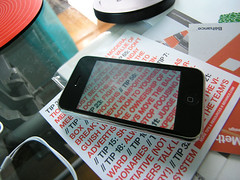
Why mobile won't kill digital signage


Image credit: John Manoogian III
To be frank, a scenario where the iPhone and other handheld devices eliminate the need for digital signage seems very unlikely, and I'll give you three reasons why:
  1. Numbers: Apple has sold about 10 million iPhones since the device's debut in 2007. Assuming that all of them are still in the US (which is mostly true), that means about 3% of the population has one. Since the device and its required service are expensive, those 10 million people will naturally clump together in the high end of the socioeconomic spectrum. Now, how many of those 10 million have done something to make themselves available to mobile marketers in the first place? (I'd be surprised if even 5% of users have done so). In contrast, Walmart TV had over 130 million viewers each month, and that was way back in 2005. Today, something like 80% of Americans shop at Walmart, giving it a reach that mobile -- even spanning all "smart" devices -- won't be able to match for a decade or more. And that's just one digital signage network.

  2. Context: Enter a store and you are, by definition, entering a place of commercial enterprise. You're probably there to buy stuff. But even if you're just browsing, there's an understanding that the retailer wants to sell you things, and you have some interest in seeing what's available. There is a shared expectation that the store will contain marketing content, and you're at least mildly interested in consuming it. Because of this, the retail store is the most natural environment for advertising that you'll ever find. And provided that retailers steer clear of using digital signage in ways that compromise viewer privacy, this mutually-beneficial relationship should remain in effect for many years to come. Don't like the content? You're free to leave, and as soon as you do, the ads are gone too. I wish all ads were so contextually relevant. TV commercials would only show up when I was in the mood to make a purchase, and newspapers would be full of -- gasp -- news.

  3. Control: Digital signs give the marketer complete control over when, where and how a message is delivered. Mobile devices on the other hand, remain in the control of the consumer. While that's as it should be, there might be a hundred different, non-commercial reasons why I whip out my cellphone. Maybe I want to check sports scores. Perhaps I'm looking up an address. I could even want to call someone. Unlike an in-store digital sign that has a fixed purpose and is operated by the store as a retail fixture, my mobile phone is mine. Unless I request the content specifically by visiting your website or sending a text message, you have no way of reaching me through my phone unless I'm part of the tiny minority that has enabled you to do so whenever you wish. (Yes, I realize that there are whole demographics that might fit into that tiny minority, and that mobile is a great medium for reaching those people. I'm talking big-picture here.)
Digital signage and mobile marketing are natural allies

People love their cell phones and are becoming more dependent on them every day. In time, more cell phone users will be willing to accept mobile marketing. It'll happen a little bit this year, a little bit next year, and in seven or eight years, the available audience will be pretty big. In the meantime, mobile marketing will focus on those niche audiences that have a natural propensity for buying the latest gadgets and giving out all sorts of personal information in exchange for a chance to win a pair of Kelly Clarkson tickets. Billboards, posters and digital signs will continue to use "easy" mobile marketing like SMS text messaging to engage viewers and measure audience interaction.

One thing is clear, though: as long as most people either don't want ads on their mobile phone (or are unable to receive them), that medium simply can't displace well-run digital signage networks. Likewise, as long as there are brands who need a guarantee that their messages will appear at a certain place and time, there will be a need for a media channel that the venue can control. Digital signage and mobile marketing are natural allies when considered in the context of multi-channel marketing campaigns, but there's simply no way that one can do the job of the other.

What do you think? Is digital signage on the verge of being replaced by another medium? Or, will emerging media actually make digital signs more important and effective?

Comments (7)

Subscribe to comments for this article | Trackback

2009-02-18Ray Lind writes:
This is an interesting subject, that has ramifications far beyond what I beleive is taking place in our present time. Consider, that all forms of digital technoloy, obviously, are effecting all of society simultaneously, at least to some degree. What those effects ultimately end up being is anyone's guess. I have to acknowledge that the content in all of these applications... mobile, t.v., radio, internet, DOOH, word of mouth, must by defintion, communicate! What is being communicated and how it is being communicated, video, audio, graphicaly, contectually and all of the "art" involved in this process gets "recognized" in different ways by various segments of socities at various times, mostly dependent on your age, economic station, social status, philosophy, political outlook, etc. at the time, you are being "communicated to". What are you interested in at any given moment is more the question? Digital signage, along with mobile communication, along with all forms of communication will always matter, one way or another. How to create... (here we go), more defining, engaging, interesting, captivating, sensational important and relevant content is what really counts.
2009-02-18June Hagman writes:
I agree, Bill, that one doesn't kill the other. In fact, we're about to use mobile to enhance our digital signs. Our hotel signage will give the guest a number to text for a special offer, directions, enter sweepstakes, etc.

We'll even have a video commercial on how to use text messaging - something that print can't do very well. We'll demo how to use texting, because there are a lot of folks who don't text yet.

Mobile isn't going to kill our network, it's going to serve it!
2009-02-18Bill Gerba writes:
I do think that digital signage operators recognize the value of using a mobile call to action (e.g. text "value" to #55555 for a coupon!") both as a way to increase engagement and measure audience participation.

As Ray notes above, it's becoming impossible to merely interact with one medium without being affected by another. Right now that plays against us when we can't coordinate everyone's efforts. In the future, though, it should improve things for both the marketer and the consumer since there will be less message competition and more cooperation (hopefully).
2009-02-18Jay Patel writes:
Bill,
Being in mobile trenches I DO AGREE that mobile is not going to kill (so violent) DS, TV, print or radio. In fact, mobile is pull media and need all of these channels in order to 'thrive'. Mobile needs these vehicles for exposure and will have a symbiotic relationship with other media for foreseeable future.
See http://www.mobilemarketer.com/cms/opinion/columns/2656.html

FYI, usage on iPhone http://maverix.typepad.com/brandingunbound/2008/10/comscore-releases-first-study-on-iphones-not-so-wealthy-demographics.html

I'm a human!
2009-02-18David Weinfeld writes:
I struggle to accept how someone could even write..."mobile marketing will kill digital signage." It's not even a vaild argument. Given that each format offers a different communication and user engagement model, it's illogical to say that one's growth would lead to the other's downfall. Did the emergence of television destroy radio? No, because they are alternate content/advertising platforms which can be used apart, or in tandem, to shape a range of marketing messages.

Mobile marketing companies such as Locamoda, Bluefire Digital, MegaPhone, and Snaptell, utilize the mobile channel in tandem with
other media platforms to achieve the greatest level of user engagement and spread targeted advertising messages. In leveraging the new media triad of the Web, mobile, and digital out-of-home, marketers increase the effectiveness and measurability of their campaigns.
2009-02-18Bill Gerba writes:
Hi Jay,

I had seen that Comscore report. Two things: first, while the lower-income segment is growing fastest, the higher-income segment is still the largest by a good margin. Second, my guess at why the lower-income area is seeing the most growth: younger people are buying them. Had they asked for household income I'd bet they would have skewed back up to the top. But for the Millenial just graduating from college and getting their first job (and probably still living at home), an iPhone isn't an affordable luxury, it's a necessity.
2010-08-11Mobile Monopoly Review writes:
Another thing about mobile marketing's cons is that the audience that can be reached via apps and smartphones is limited. Not everyone is using a smartphone - marketers should consider this factor too.

Leave a Comment

Name:
Email Address:
(required but won't be shown)

Website:
Comment:
(max 2000 characters)
Are you a human? If so, uncheck this box:


Digg this! | Del.icio.us


Previous Article: Beyond the Digital Signage RFP: Why You Need a Content Strategy
Next Article: Small Retail Stores, Core Customers and the Future of Food

Front page of Digital Signage Insider Blog

LEGAL STUFF: The Digital Signage Insider is written by multiple authors. The author of each article is clearly identified at the start of the article. The opinions expressed in each article are solely those of the author, and do not reflect the official opinions of WireSpring Technologies, Inc. All articles are copyright © 2004-2009 by their respective author. All content besides the actual article text, e.g. surrounding branding and informational content, is copyright © 2000-2009 WireSpring Technologies, Inc. All rights reserved. Except as provided in WireSpring's Republishing and Syndication Policy, no articles may be reproduced, in whole or in part, without WireSpring's express written consent.

Subscribe to our RSS feed


  Subscribe via XML/RSS/RDF

About this blog and our team
WireSpring provides hardware, software and services for digital signage and kiosk projects. But this blog is a labor of love. Our posts cover everything from case studies to creative briefs, and we post new articles several times a week.

The blog team:

Our blog team includes some of the industry's most well-respected leaders:

Founder and Senior Writer:
Bill Gerba

Editor:
Jeremy Zaretzky

Writers:
Gary Halpin, Agency 225
Pat Hellberg, Kaicon
Hercules Huggins, WireSpring
Dr. Alice Julier, University of Pittsburgh
Darren Kubel, WireSpring
Christie Liu, Strategy Institute
Graeme Spicer, Adcentricity
Axel Vera, Infusion Marketing
Roberto Vogliolo, Artexe

If you would like a member of our blog team to provide feedback for a story you're working on, or you want them to speak at your event, please contact us.

Editorial policy:

Article topics are selected by our writers and editors, with the goal of providing objective and useful information to the entire digital signage industry. This means covering a lot of projects that have nothing to do with WireSpring's products, and we're fine with that. Whenever we mention a project that WireSpring is directly involved in, we'll be sure to provide appropriate disclosure in the text. If you'd like to suggest a topic for a future article, feel free to leave a comment or contact us. We don't take very kindly to PR spam, so please review our past articles before contacting us to verify that what you're planning to send is a good fit for our audience.